60
hard sets a week on the standard target — ten for each of six muscle groups
You can’t kegel or reverse kegel your way out of bad circulation. Stamina, staying hard, how fast you recover — all of it runs on blood flow, and blood flow is a whole‑body system: your heart, your circulation, your body fat, your sleep. Pelvic floor work is half the job. The other half is being in shape.
Most men skip that half because an hour a day does not exist. So it does not happen. Not this month, not last month either.
Your muscles cannot tell where they are. A muscle has no idea whether it is in a gym or your kitchen. It knows one thing: how close that last set came to failure. Equipment never built anybody. Getting to the edge did. Equipment is just the fastest way there.
Which means eight push‑ups that leave you shaking beat twenty easy ones. A doorframe and real effort is a set. Stopping at “that was enough” is not.
So this counts hard sets, not workouts. Forty seconds at a time — floor, wall, kitchen counter — in gaps that are already in your day.
Finish your sets by the end of the week. That is the only target there is. No session to schedule, no daily streak to protect, nothing to be late for. Clear the week and you grew this week.
No card, no account — three days of the whole app, counted from when you actually train rather than from a clock. Keep it for one payment of $24.99, or walk away and owe nothing. No subscription, ever.
Spread out, you can go harder than you could in a gym. A lifter rests two minutes between sets, so set four lands on a body that never recovered from set three. Your sets are hours apart. Every one starts fresh, and a fresh set is one you can take all the way down.
That is the trade. You give up the barbell and you get back the thing that actually decides whether a set grew anything: how close to failure you were willing to go.
Which is why you cannot coast. A gym guy can be sloppy — four sets of chest back to back, and if two were soft the other two carry him. You do not have that cushion. Your set is alone in a hallway with nothing behind it to make up the difference. A set with five reps left in the tank is a warm‑up wearing a set’s clothes, and a week of those is how men train for months and change nothing.
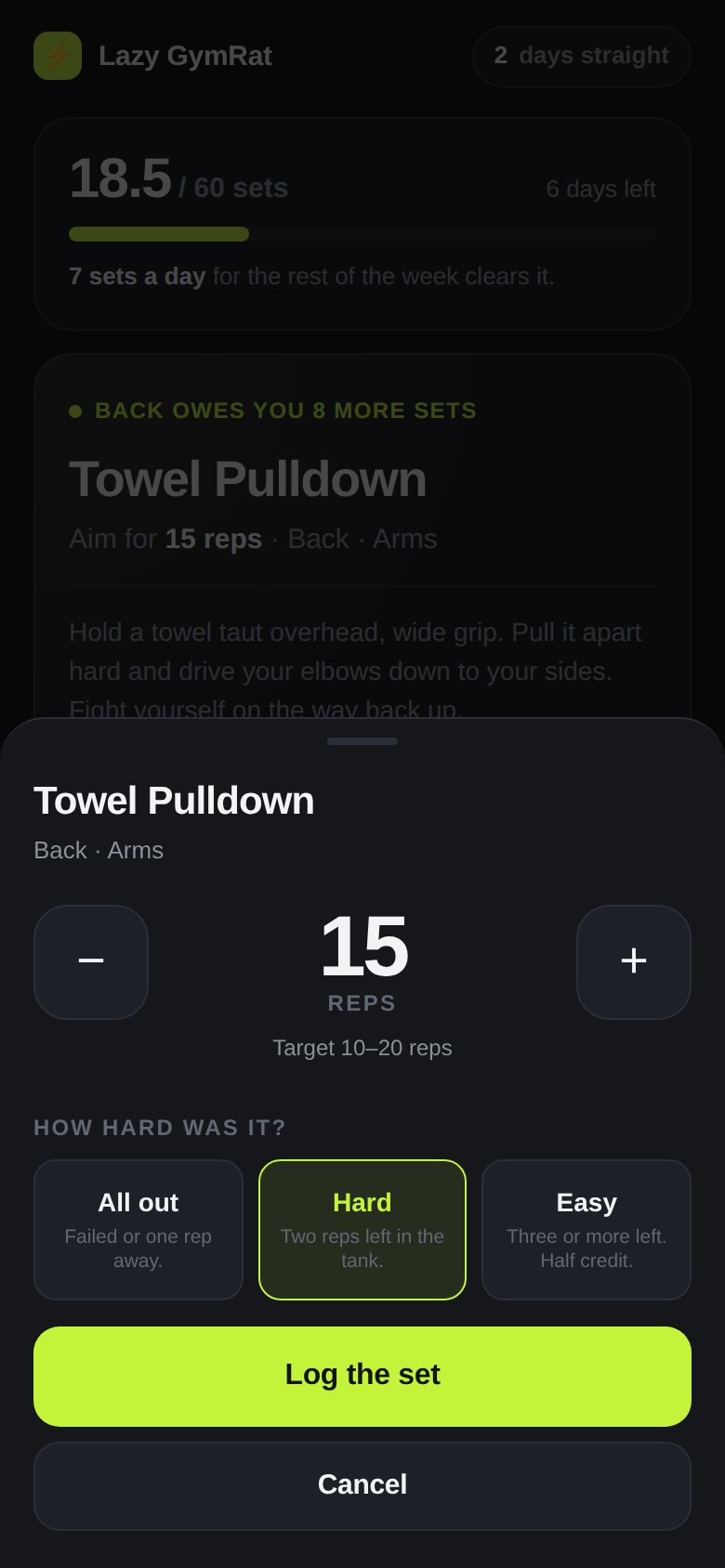
So the app makes you say it out loud. Every time you log you pick All out, Hard or Easy — and an easy one earns half credit and tells you why.
That is the entire ask. Six minutes, cut into forty‑second pieces. The reason it works is not that it is clever — it is that there is no version of your day that cannot fit it.
You ate everything she ate for nine months. She got a baby out of it. You got a gut. The only hours that belong to you now are the two after bedtime, and a gym trip costs ninety minutes of them. Nobody is coming to hand those back.
Classes, a shift, the library, and a day full of forty‑minute holes — not one of them long enough to change, travel, train, shower and get back. The gaps are there. They are just the wrong shape, and you stopped trying to force them.
You will go. When you are in better shape, when you know what you are doing, when you will not be the weakest man in the room. That feeling is real and it does not fade on its own. Until then the floor of your own room is free and nobody is watching.
Long days, travel, shifts that move. Any plan built on being somewhere at a set time was dead before you downloaded it, and you already know which week you would miss. This one goes wherever you already are.
Knees, hips, back, or just fifty‑five years of wear. Getting down is a project and getting up is worse, so every home workout ever written quietly excluded you. Switch the floor off and it never comes up again — a wall, a counter and a sturdy chair still cover all six muscle groups.
Different lives, same problem: the hour never shows up. Nothing here needs one. Forty seconds, a few times a day, is the whole ask.
“I love how this is so practical and how the app holds me accountable with how many sets and reps I’ve done.”
“omg! Bro this is a brilliant idea and it’s been helping me tremendously since the first day I bought it!”
“I love the name of the app and love how it actually motivates me to work out. Aiming to hit that weekly quota next week! 😎”
This opens your email app with the message ready to send. Nothing is submitted anywhere else, and nothing about you is stored on this site.
Checkout isn’t connected yet — add your checkout link to BUY_URL at the top of this page.
No gym bag. No change of clothes. No hour blocked out. Six sets that each count toward the week, taken in the gaps that were already there.
Six hard sets. Four minutes and twenty‑five seconds on your feet, spread across fifteen hours. Every one of them counts toward the same weekly total a gym session would have built.
I’m not going to ask if you’re a beginner. Nobody knows the answer to that.
Instead he has you do one max set on the spot and reads your starting level off the number, then sets all fifteen progression ladders to match — so the first move you are handed is already the right one, not a guess you made about yourself in a dropdown.
That set does something else too. The burn on your last rep becomes your reference point for All out, which means every set you log afterwards has something real to be measured against. Then he steps back, and returns at the four moments that decide whether anyone keeps going: your first logged set, your first properly scattered day, the week you fall behind, and the week you clear quota.
Yes — and not as a compromise. Three things are true about how muscle grows, and all three work in your favor here.
Muscle grows in response to hard sets taken close to failure. A workout is only the container those sets arrive in. Your body counts the sets; it has no way of knowing whether they came in one trip or six.
Everyone who studies this counts training the same way: hard sets, per muscle, per week. Not per session — per week. So ten hard sets for your chest is ten hard sets whether you did them all on Tuesday or spread them over seven days.
In a gym you rest two minutes between sets, because you are trying to get out of there. Spread across a day you get hours between them. Every set starts fresh, so every set can be taken closer to failure — and how close to failure a set was is the thing that decides whether it grew anything.
What it will not do: match a committed lifter under a loaded barbell. Nothing bodyweight will, and anyone telling you otherwise is selling something. But that is not the comparison that matters. The comparison that matters is against the hour you keep not doing — and against that, this wins every single week.
Training spread through the day in short, hard bursts has been around for decades under several names. You are not the test subject.
Pavel Tsatsouline’s term for treating a lift as a skill you practise often through the day rather than a session you survive once. Long-standing practice in strength circles.
The name exercise scientists gave to very short bouts of hard effort scattered across a day, as opposed to one continuous block. An active area of published research.
Mark Sisson’s version of the same instinct, aimed at people who sit all day: brief, frequent, at home, no session to schedule.
Every one of them tells you to scatter hard sets. Not one of them tells you how many. There is no quota, no way to know whether a week counted, no signal that a move has got too easy. You are left doing push‑ups in a hallway and hoping.
That gap is this product. The Lazy GymRat is the bookkeeping the method never had: a weekly number for every muscle, credit for how hard the set actually was, a pace line that tells you where you stand, and a ladder that moves you up when a move stops costing you anything. The approach is proven. The counting is what was missing.
Floor, wall, counter, chair, doorframe, stairs, a towel, a loaded backpack. Switch on only what you actually have. Anything you leave off, the app never asks you to use.
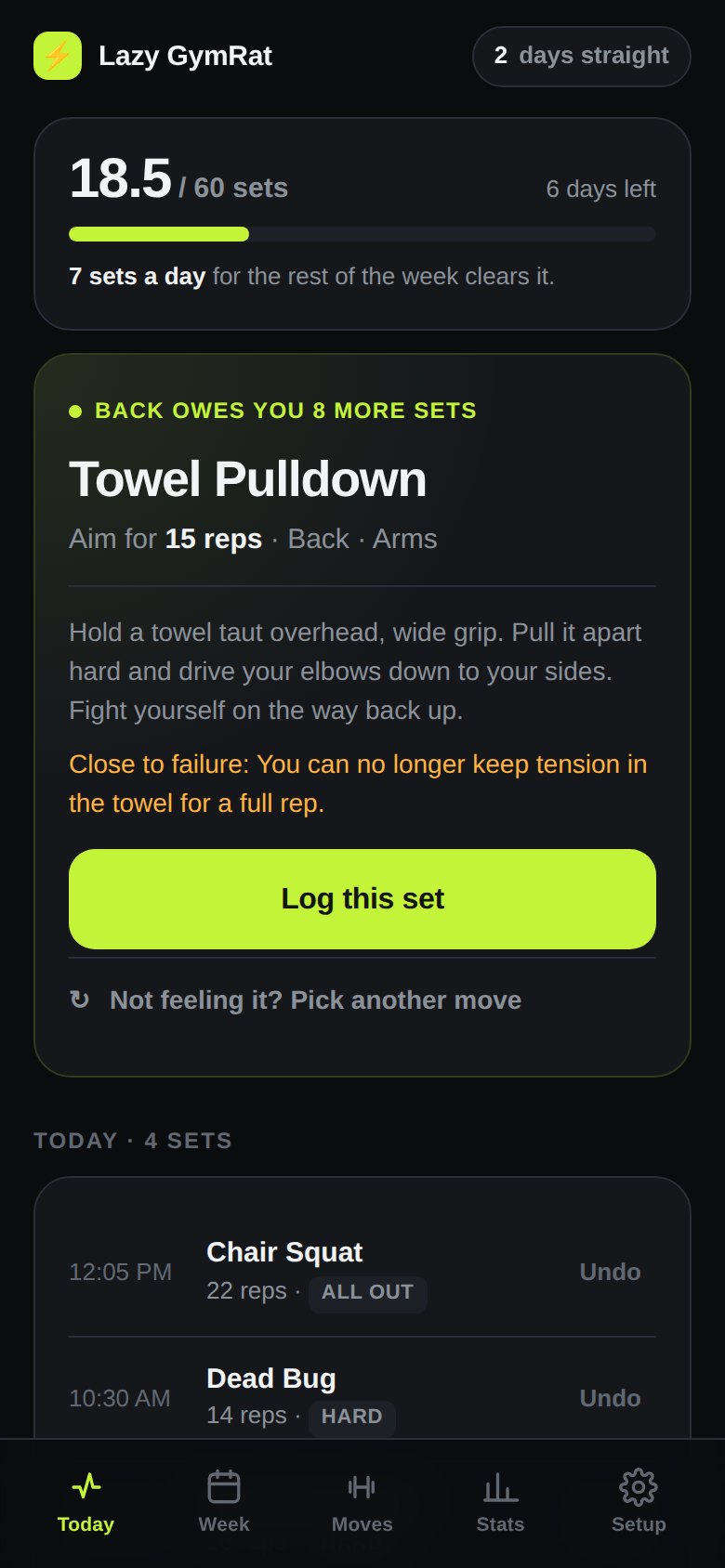
It hands you a single move with the reps to aim for and how to know the set was hard enough. Forty seconds. Two taps to log it. Then get on with your day.
A number of sets per muscle, due by Sunday. That is the only deadline in the app. Miss a morning, miss a whole day, nothing is ruined — you simply have fewer days left to fit the rest into, and the app works out the new daily number for you.
Sixty‑two moves on fifteen progression ladders, sorted the way you already think about a body. Every move tells you which muscles it trains, how to do it, and how to tell the set was hard enough.
Chest, shoulders, triceps.
Back, biceps, grip.
Quads, glutes, hamstrings, calves.
The chain that holds you upright all day.
Every ladder runs from something you can already do to something you cannot do yet. You never have to pick a move. The app hands you the one your week is short on, and bumps you up a rung once that one stops being hard. The shelves are just so you can see the whole thing laid out.
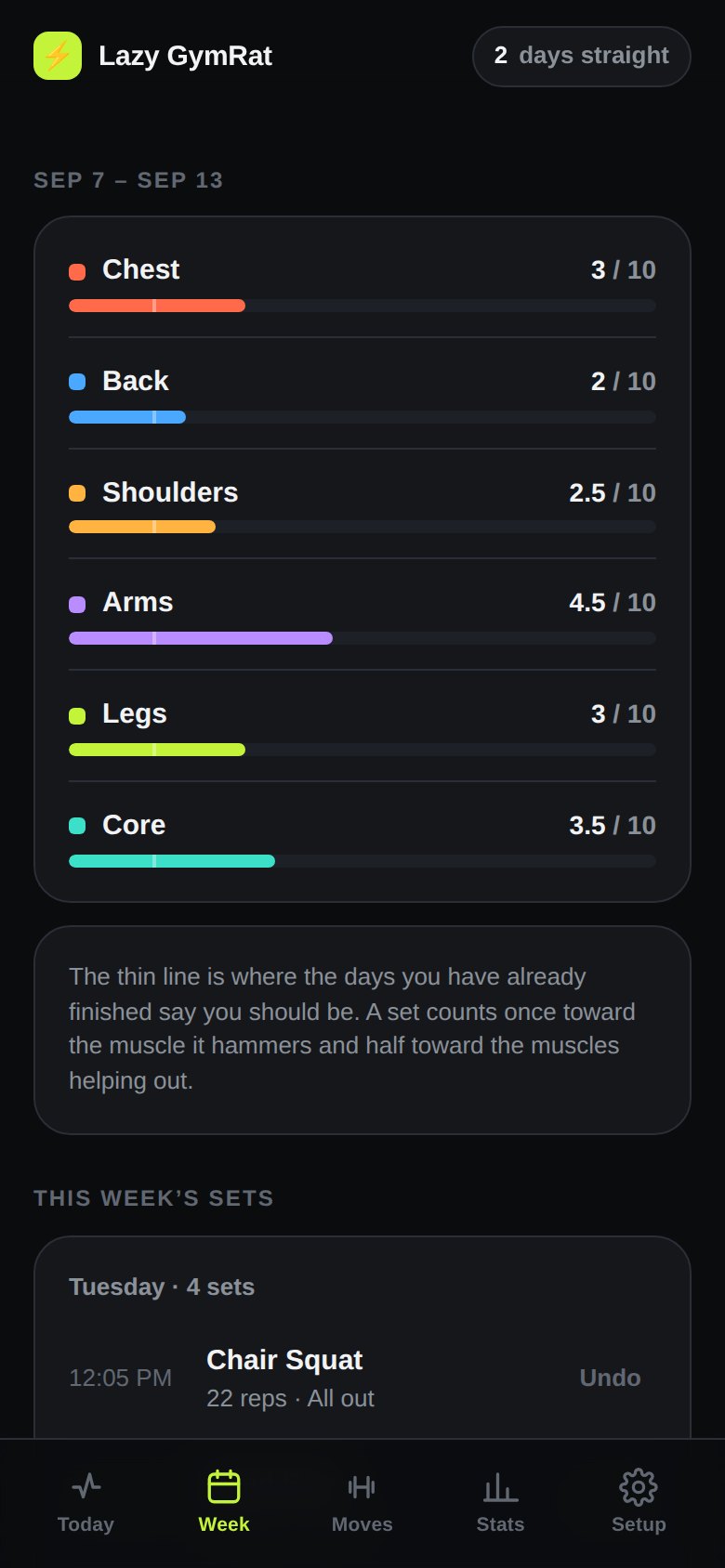
One number per muscle, and one screen that tells you at a glance how much of the week is left. A set counts as a full set for the muscle doing most of the work, and half a set for the muscles assisting — a push‑up is a full set of chest and half a set each of shoulders and triceps. That is the standard way training volume is counted.
The thin marker on each bar is the pace line: where you would be if you had spread the week evenly across the days that have already gone. Bar past the line, you are ahead. Bar behind it, you are behind — and that is the whole of “am I on track?”, answered in a second. Fall behind on Wednesday and nothing is lost: the app just starts handing you whichever muscle is furthest back until the bars are level again.